Deutsche Podcasts
One of the “new” things I started doing in 2020 was start listening to podcasts. I felt that I was delayed in jumping on the bandwagon, seeing as how many friends and colleagues in London listened to podcasts to survive the hours commute. (True crime podcasts were seemingly a hit.) I don’t know why I didn’t add listening to podcasts during my commute and instead chose to while the time away with reading and language learning on DuoLingo.
This year, as we spent more time at home, I started listening to German language podcasts to continue training my ear to how the language was spoken by native speakers. It was also a window into the cultural world of the DACH region (Deutschland Austria CH = Confederation Helvetia, aka Switzerland) and understanding the general worldview, interests, and worries of this part of the world I now call home.
Here are some of my favourites —
Easy German
Part of the Easy Language group that promotes language-learning through interviews with people on the streets, Easy German started out as a YouTube channel and has recently expanded into the podcast world.

They host three episodes per week on Tuesday, Thursday and Saturday (repetition and frequency is an advantage for language learners), each hosted by Cari and Manuel of the Easy German team, with special guest appearances by Janusz, Isi, and other. A huge variety of topics are covered, from moving house, to the education system in Germany, to moaning about the quality of the internet in Germany.
The episodes are no longer than half an hour each, so completely digestible for a lunch break. The conversations between Cari and Manuel are natural and genuine, with real talk about fluctuating moods (though Cari seems to be in a perpetually cheery mood even when moaning about the quality of internet. Her laugh is contagious!) or the current situations of Corona and the US elections. There are regular segments, like Thema der Woche (theme of the week), Das nervt! (That’s annoying), and Das ist schön (That’s nice), and Cari makes liberal use of her sound machine to mimic applauses or boos, depending on the topic. The speed of conversation is easy to follow and not too slow for more advanced language learners, either.
I’ve also recently started supporting Easy German on Patreon where you can get extras like more vocab lists and language worksheets per episode, as well as behind the scenes cuts on both the YouTube videos and Podcast episodes. They’ve recently recorded their 100th podcast episode LIVE on YouTube, with questions from viewers and regular listeners — you can find the listening only version here or the recorded video here.
Servus. Grüezi. Hallo.
Part of the suite of podcasts hosted by German newspaper Zeit, Servus Grüezi Hallo is a ‘trans-alpine’ podcast that brings together three Zeit journalists from the DACH region to discuss current affairs that affect the three countries. This was actually the first German language podcast I listened to, back when I couldn’t understand most of the conversation, but wanted to train my ear to listening to native German speakers speaking. It’s also a good trainer for distinguishing the nuances in accents — everyone speaks Hochdeutsch, but lately Matthias (the Swiss guy based in Zürich) and Florian (the Austrian guy, mostly based in Vienna but also is sometimes based in Innsbruck) have been infusing their local dialect idioms in conversation.

The episodes are about 45 minutes each, with a longer time spent on one ‘serious’ topic, like the ever-present Corona situations in each of the three countries or the recent terror attack in Vienna, and the last part of the episode to talking about something more light-hearted, like German bread or yodeling. They also do short snippets of personalities in each country that’s worth knowing (Dieser Deutscher / Österreicher / Schweizer sollten Sie kennen) or a quirk about each country that confuddles the others (Die spinnen, die Deutscher / Österreicher / Schweizer).
My husband is German by birth but has spent a large portion of his live in Innsbruck, Austria and now we live in German Switzerland, so it was fun to introduce this podcast to him. He’s confirmed stereotypes about each of the DACH countries that now form part of his identity — as an honorary Tiroler, he likes to poke fund at how Florian, the Austrian is stereotypically Viennese, and we now call Canton Bern our home, so some things that Matthias says as a Zürcher make us cringe or giggle. Over time, I overcame the difficulty of the language and can now understand the majority of topics, only looking up a handful of words to confirm the meaning I presumed. Both of us have started listening to new podcast episodes together when they come out on Wednesdays.
Servus Grüezi Hallo also did a special anniversary episode where they answered questions from listeners from the DACH region — accents abound! It was affirmation for me, who’s only been here 2.5 years and passively absorbing the dulcet tones of Swiss German (more specifically Bärndütch), to understand the gist of what Swiss listeners were saying. The other two hosts (Lenz, who’s based in Berlin and Florian, the Austrian) were dumbfounded and always asked Matthias to translate. Check it out here.
DW Deutsch lernen
The media company Deutsche Welle also has fantastic resources for language learning (their app, Nicos Weg, is aimed at A1 to B1 levels and was my first “proper” set of German language lessons). Their set of mini-podcasts are perfect for brushing up on Redewendungen (idioms and phrases), as well as learning about etymologies of a word or listening for longer than a couple of minutes to a certain topic.
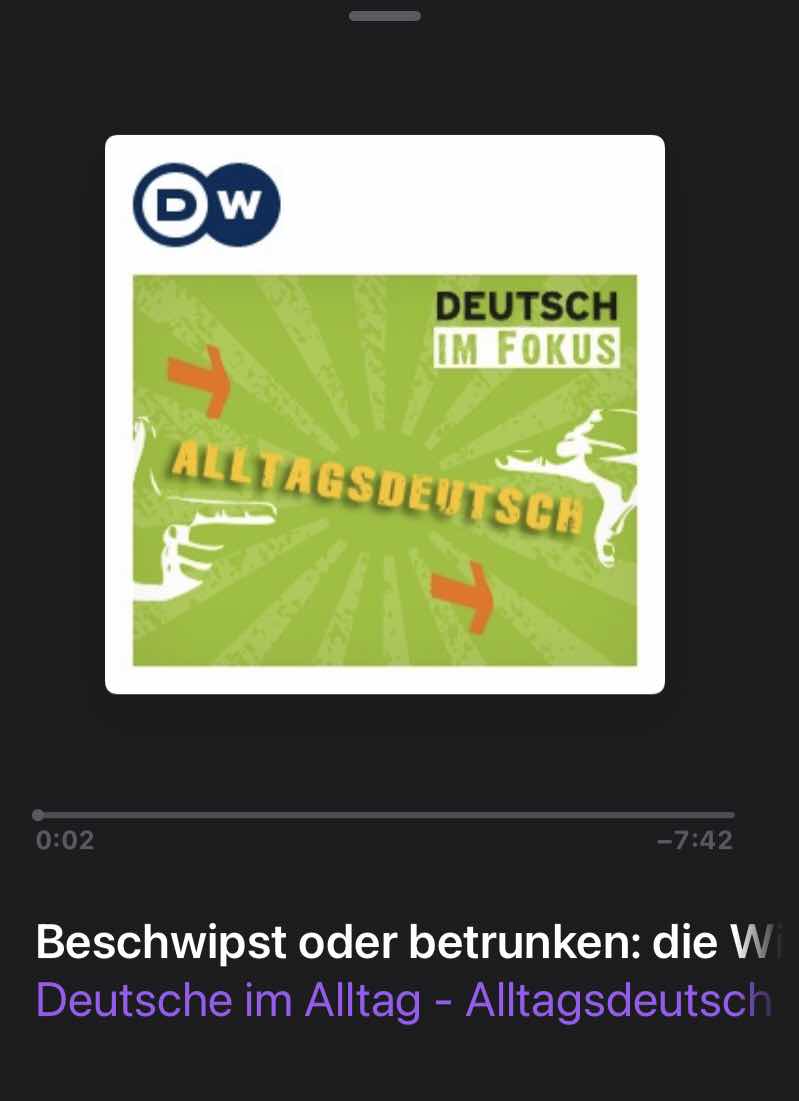
Unlike the above two podcasts, DW Deutsch lernen podcasts are typically slower in the speed of talking, but that’s always a big help for any language learner, even at the advanced levels. (Side note: after living in Canton Bern, where the local dialect is generally slower and ‘sweeter’ than other Swiss dialects, people also usually speak Hochdeutsch slower. I’ve really gotten to used to the speed of speech and am sometimes taken aback at how fast Zürchers can tend to speak. I also find that many speakers in Germany also speak quite fast.)
Deutsche im Alltag - Alltagsdeutsch episodes last no longer than 10 minutes and cover a range of topics that are a part of daily life. Some of my favourites are Beschwipst oder betrunken (different ways to describe levels of being under the influence of alcohol), Wiens sozialer Wohnungsbau (Vienna’s historical social housing), and Wenn die Traum lautstark bimmelt (featuring the trams of Zürich). Das sagt man so! are 2-3 minute snippets of common phrases, like einen Ohrwurm haben (to have an ear worm) or seinen Senf dazu geben (to always have an opinion on something). These are particularly useful to add to conversations, as it shows native speakers that you are familiar with common phrases. Sprachbar is another one that lasts no longer than a few minutes, focusing more on nuances of the German language, quotes from literature or historical figures, and sometimes a little bit of grammar (can’t escape it).
Halbe Katoffl
This podcast is a recent discovery and has fast become one of my favourite ones. German journalist Frank Joung interviews Germans with non-German roots — people who grew up with a German and non-German parent (hence Halbe Katoffl, or half a potato), people who emigrated to Germany and have settled there. There are of course the overarching themes of immigration, integration, and identity, but the long episodes (some can last to 1.5 hours or 1 hour 45 minutes) feel like a comfortable conversation with good friends.
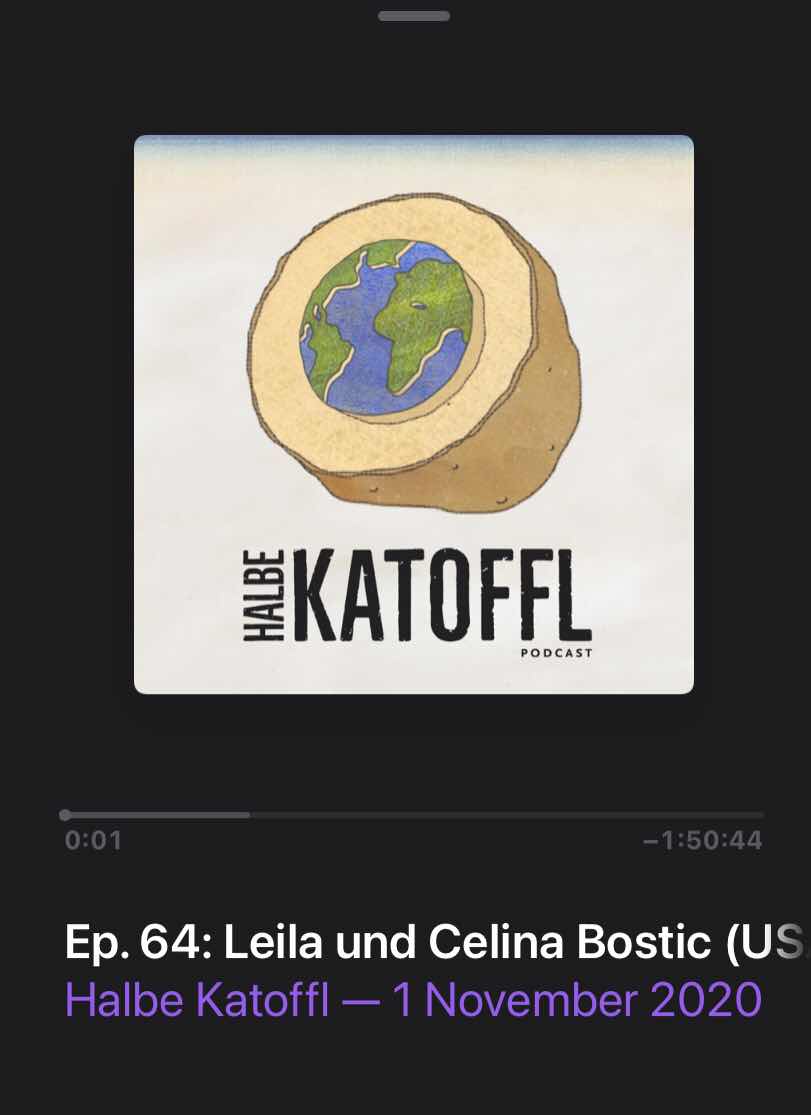
As someone who has many definitions of ‘home’ or Heimat, I felt this one really gets to the nuances and details of people’s lived realities that don’t make it to sociological theories or migration politics discourse. Though the people featured in the podcast literally come from everywhere in the world and have lived in Germany since childhood or migrated there as adults, the feelings of being a foreigner or the need to fit in or always standing out really resonate with my own personal experience. Not necessarily in a negative way, but more in a way of solidarity and the feeling of being ‘seen’ (heard?) as a human being and not as just as a non-white person in a majority white society.
Swiss podcasts
I’ve also dabbled with listening to Swiss podcasts, which are mostly in Swiss German, thus making the learning process a bit more challenging. But I live in Switzerland now, and I follow the advice of many Swiss people I’ve met: learn and speak Hochdeutsch / Schriftdeutsch (High German, which is essentially also a foreign language here), but also learn to at least understand your local variant of Swiss German, since these are your neighbours and community. It’s also quite difficult to learn to speak Swiss German for many reasons, one of which is that there are so many dialects across the country!

SRF is the national TV and radio company for German Switzerland and they have podcasts across the board, covering their programming on all their running radio channels. One of my favourites is the short and sweet Morgengeschichte (morning story), which is a daily short story read aloud within a minute or two, breaking up the monotony of the news programmes on SRF1. If you’re into listening to the news, the Echo der Zeit goes a little deeper into the news headlines with daily episodes lasting anywhere from half an hour to 45 minutes. I’m partial to SRF2’s Kultur channel and the Kontext podcast, which dives into art, culture, society, and science in hour-long weekly episodes. There’s also a shorter podcast called 100 Sekunde Wissen, that covers a topic in just under two minutes.
One of the top independent Swiss podcasts is Kafi am Freitag a podcast hosted by two Swiss women who sound like they’re having a nice catch up over Kaffee-Kuchen, with lots of laughs about the seriousness or absurdity of it all. The episodes have been sporadic this year (thanks Corona) and they’re rather long (average 1.5 hours), so I often listen to them when I’m out on a walk.
—————
With this amount of podcasts I’ve listed, it may seem like that’s all I do! Well, yes and no. Podcasts are a nice companion to every-day activities, whether I’m going for a walk, or doing housework, or knitting / crocheting. It’s like listening to the radio, but you don’t have to deal with the ads or the news breaks, and you get to listen to what to you want.
Do you listen to podcasts?

Comments
Post a Comment